
Analyse Material with Confidence PGNAA Technology
Elemental Analysis technology has evolved rapidly over the last decade and plays a critical part in mining operations, allowing plant operators to make decisions based on the composition of elements. The decline in ore quality, increasing material demand, rising production expenses, and evolving plant requirements underscore the importance of obtaining real-time elemental data to improve process control.
Prompt Gamma Neutron Activation Analysis (PGNAA) technologies are the premier method of analysing material composition, and has been in use for over 40 years.
What is PGNAA?
Prompt Gamma Neutron Activation Analysis is internationally accepted as the preferred option for high performance on-line elemental analysis. In PGNAA, conveyed material on the feed stream is exposed to neutrons emitted from a radioactive isotope or neutron generator. It is a non-contact, non-destructive analytical technique that is widely used in mining industries to obtain information in real time on the composition and moisture content of coal, iron ore, copper, lithium and more.
How Does PGNAA Technology Work?
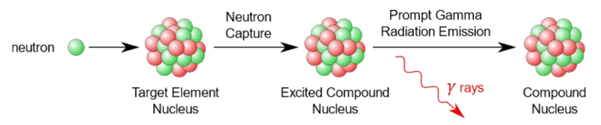
PGNAA technology works by continually bombarding material with neutrons, either from a Californium 252 (Cf-252) source or from an electrical neutron generator. When neutrons collide with an element in the material, gamma rays are emitted with specific energies unique to that element – in effect creating a spectral signature for that element. The higher the concentration of an element in the material, the greater the number of gamma rays emitted with the corresponding specific energies. By measuring the specific energies of the emitted gamma rays and the intensity of each specific energy, an accurate analysis of the chemical elements of the material is generated in real-time.
The Advantages of PGNAA Technology
Real Time Results
Accurate Analysis
PGNAA technology provides much more information than just ash or moisture, as they can also directly measure individual elements like Fe, Al, Si, K, S, Ti & Ca. Sensors using this technology also have a higher tolerance to changing coal types, eliminating the need for multiple calibrations.
Increases Material Value
Complete Measurement
PGNAA's Role In Mining
Success in mining operations stems from having the most accurate information readily on hand. By providing accurate, real-time data on material composition before stockpiling or processing facilities mining operators can increase the product quality and reduce operation costs.
The value of material is constantly in flux from the moment it is extracted from the earth, as it is exposed to the elements and moisture. Placement of an analyser is critical for obtaining data at the right time, with typical PGNAA placed as early in the mining process as possible. Analysers are situated above the conveyor belts, allowing for constant scanning and measurement of material passing beneath. These belts have loadings upwards of 400kg/m and speeds exceeding 5m/s. This means that analysers need to be able to provide data and information quickly to ensure accurate decisions can be made.
PGNAA has seen successful implementation across the mining industry due to the large range of measurable elements including Fe, Al, SI, K, S, Ti, Ca and many more. The coal industry for example, benefits greatly from PGNAA analysers as the sensor can determine ash, moisture, and specific energy data. Without the use of an analyser, determining material composition requires waiting for laboratory results which can take 2-3 days for critical results.
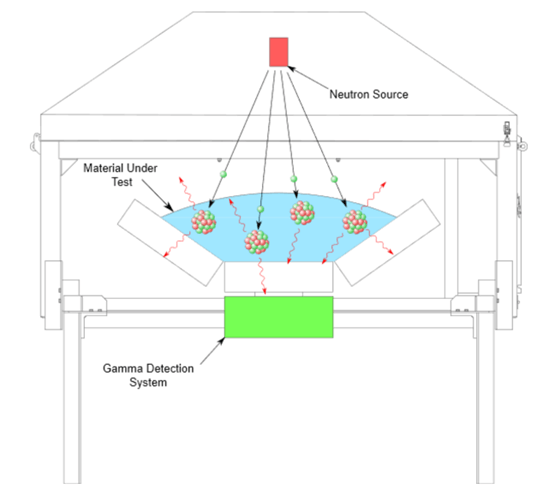
The standard configuration of a PGNAA analyser, incorporating neutron interactions, is depicted above. In the illustration, there is a neutron source positioned above the material on a conveyor belt, continuously subjecting the material to neutron irradiation. A portion of these neutrons is absorbed by elements within the material, leading to the release of specific gamma rays during the neutron capture interaction. Some of these gamma rays penetrate the scintillation crystal beneath the belt, generating an electrical response that is then detected by the sensor. This detected response is utilized to deduce the elemental composition of the material.
Sensors Harnessing PGNAA Technology

AllScan Elemental Sensor
The AllScan Cf252 is an advanced elemental cross-belt analyser, harnessing world-best innovation and smart technology, to deliver real time data based decision making in mining.
Utilising the well-established technique of PGNAA (Prompt Gamma Neutron Activation Analysis), the AllScan Cf252 can perform direct measurements of elements such as Fe, Al, Si, K, S, Ti, Ca and many others, across the entire profile of material
The sensitivity varies depending on the element being measured, so some elements can be detected with greater sensitivity than others – for example iron (Fe), sulfur (S), calcium (Ca), mercury (Hg) and titanium (Ti) are all especially sensitive.
